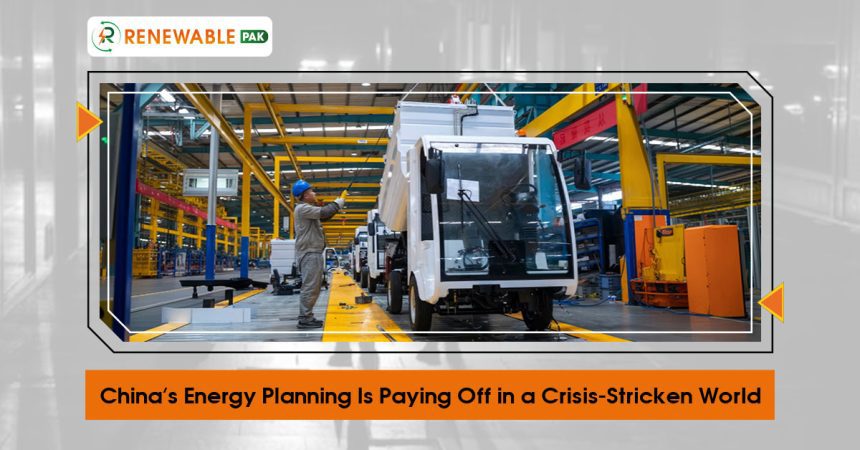
China’s Energy Planning Is Paying Off in a Crisis-Stricken World
As global oil markets reel from conflict and uncertainty, China’s long-term energy planning is proving to be one of its most strategic advantages.
When global energy markets are thrown into turmoil, countries are tested not just by what resources they have, but by how well they planned for disruption.
That is exactly what the latest Middle East crisis has revealed. As tensions between the United States and Iran sent shockwaves through oil markets and revived fears over the Strait of Hormuz, many economies were left exposed to the same old vulnerabilities: dependence on imported fuel, limited strategic reserves, and little room to absorb another external shock. China, however, has entered this period with a far stronger hand.
The reason is simple. China’s long-term energy planning is now paying off.
For years, Beijing has approached energy not merely as a supply issue, but as a matter of national strategy. While many countries have treated energy policy as a reactive exercise, responding to price spikes, shortages or geopolitical shocks only after they happen, China has spent more than a decade building the infrastructure, reserves and diversification needed to withstand precisely this kind of moment. (theguardian.com)
That energy planning is visible on multiple fronts. China has built vast strategic petroleum reserves, expanded domestic backup systems, diversified crude supply routes and invested aggressively in alternatives that reduce long-term dependence on imported oil. It has also led the world in renewable energy capacity, battery storage, electric vehicles and power grid expansion, all of which now serve not only climate goals, but economic and geopolitical ones too.
This is what makes China’s position so different in today’s crisis. It is not that the country has become immune to global oil volatility. It has not. China remains one of the world’s largest crude importers and would still feel the impact of any prolonged disruption in shipping routes or sustained rise in prices. But it is better insulated than many of its regional peers because it planned ahead.
That distinction matters more than ever.
The Strait of Hormuz remains one of the world’s most important energy chokepoints, with roughly a fifth of global oil passing through it. Any threat to that route sends immediate ripples through Asia, where energy security remains tightly tied to imported fuel. For economies that have failed to prepare, even a temporary disruption can trigger inflation, trade pressure, industrial strain and public anxiety. (reuters.com)
China’s energy planning has given it something many countries lack in these moments: time. Strategic reserves create breathing room. Diversified energy sources reduce panic. A stronger renewable base lowers pressure on fossil fuel demand. Electrification in transport and industry softens the blow of oil shocks in ways that are now becoming increasingly visible.
This is why energy planning can no longer be seen as a technical or bureaucratic matter. It is now central to economic resilience.
In fact, one of the clearest lessons from the current crisis is that energy transition and energy security are no longer separate conversations. For years, renewable energy has often been framed largely through the lens of climate responsibility. But what China demonstrates is that renewable investment also functions as strategic protection. Every solar project, every wind corridor, every battery installation and every electric vehicle on the road contributes to reducing a country’s exposure to unstable global oil markets.
In that sense, China’s energy planning has been far more than an industrial policy. It has been a hedge against geopolitical uncertainty.
That does not mean its model is flawless. China’s economy still relies heavily on imported crude, and any prolonged conflict in the Gulf would still carry serious consequences for its refining sector, manufacturing base and freight systems. Independent refineries have already faced pressure from higher crude costs and tighter margins, underscoring the fact that no country is fully shielded from global disruption. (theguardian.com)
Yet the difference lies in scale and preparedness. China may still face the storm, but it is far less likely to be overwhelmed by it.
That contrast should not be lost on the rest of Asia, particularly countries like Pakistan, where external oil shocks can quickly become domestic crises. In Pakistan, rising oil prices do not remain confined to energy markets. They spill into transport costs, food inflation, electricity burdens and broader economic instability. For countries with limited buffers, every global disruption carries immediate local consequences.
That is also why the latest ceasefire between the United States and Iran matters beyond the immediate politics of war. The provisional two-week pause has helped calm markets and reduce fears of a larger supply shock, at least for now. It has also created space for diplomacy to temporarily steady one of the world’s most sensitive energy corridors. (reuters.com)
Pakistan’s reported role in helping facilitate that pause is therefore especially significant. Islamabad appears to have played a useful diplomatic role in encouraging de-escalation at a time when any prolonged conflict would have been economically disastrous for the wider region. That intervention reflects an important reality: in today’s world, diplomacy and energy planning are increasingly connected. Stabilising a conflict zone is no longer only about politics or security; it is also about protecting trade, markets and national resilience. (reuters.com)
Still, diplomacy can only do so much. A ceasefire may ease immediate pressure, but it does not erase the deeper lesson of this moment.
The real winners in an energy crisis are not the countries with the loudest reaction, but the ones that did the quiet work years earlier.
China’s long-term energy planning has given it a strategic edge at a time when much of the world is once again being reminded how fragile energy security can be. In a crisis-stricken world, preparedness is no longer optional. It is policy, protection and power all at once.
And right now, China looks like one of the few countries that understood that in time.